










Google’s AI Max: The Latest Evolution of Search Ad Monopoly
At Lighthouse, we constantly monitor global shifts in the digital advertising landscape to keep our partners one step ahead. A recent research article sheds light on Google’s latest move, the launch of AI Max, a development that could redefine how businesses approach search advertising. This innovation is not just a technological update; it’s a strategic play by Google to reinforce its dominance and reshape the rules of the game for advertisers worldwide.
And this raises the fundamental question: We now have AI Max, but why did we get here and most importantly, how? The simple answer is because the tech giant (Google), the gatekeeper of search, both organic and paid, wants more revenue than it already generates.
It also wants to keep its dominance in the market. It can do so by:
But here’s the important part: how can Google maintain this market dominance while facing unprecedented regulatory scrutiny?
From Keywords to Behavioral Targeting: a 25-Year Arc
Why it matters: Search has always captured the high-intent moment, the part of the funnel closest to conversion. AI Max intensifies that by using deep context and user signals to decide who sees what and what you pay.
What Marketers Must Do Now
Final Takeaway
AI Max marks the culmination of Google Search's shift from keyword auctions to behavior‑based pricing wrapped in layers of automation and proprietary data. Advertisers gain scale but lose insights. Success now depends on mastering AI Max with oversight, transparency, and a diversified strategy.
👉For a full understanding of this critical development, we recommend reading the complete article here
And this raises the fundamental question: We now have AI Max, but why did we get here and most importantly, how? The simple answer is because the tech giant (Google), the gatekeeper of search, both organic and paid, wants more revenue than it already generates.
It also wants to keep its dominance in the market. It can do so by:
- Delivering a satisfactory amount of results to its clients, even if only marginal, and
- Getting more control over market processes and customer behaviors, that is: access to more real intent data.
But here’s the important part: how can Google maintain this market dominance while facing unprecedented regulatory scrutiny?
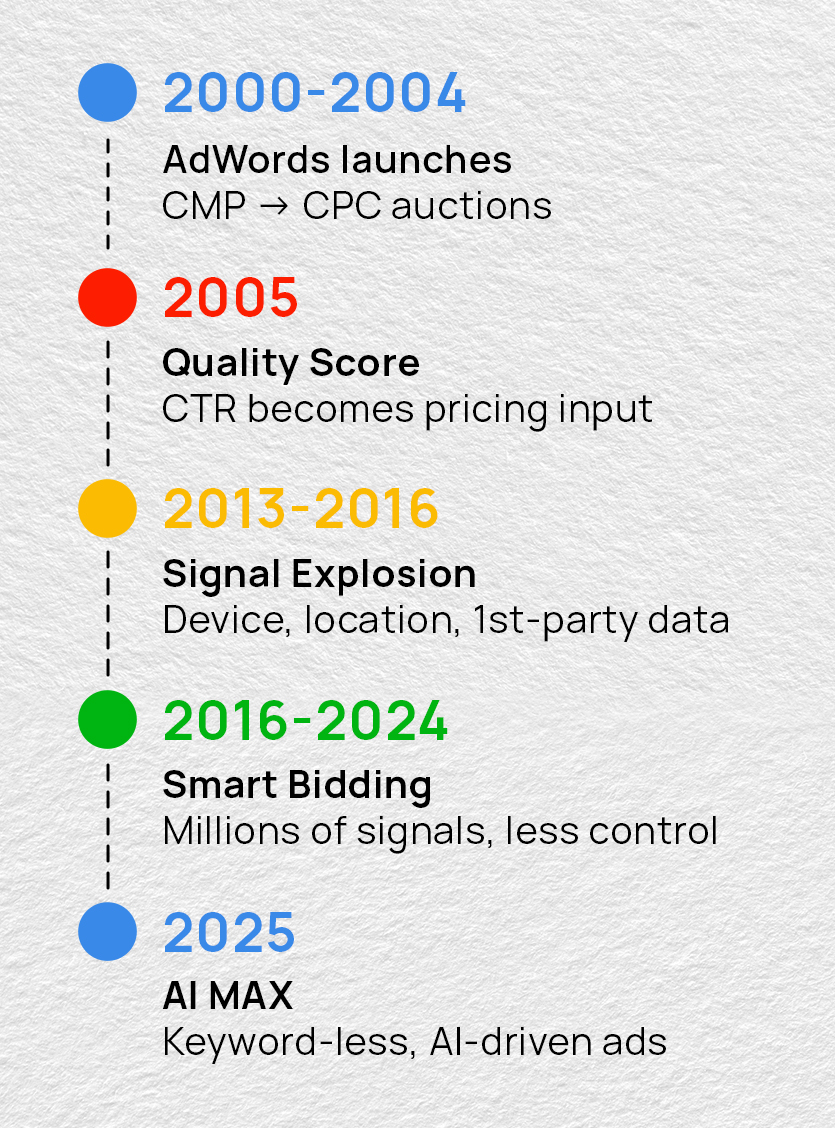
From Keywords to Behavioral Targeting: a 25-Year Arc
- 2000–2004: Google launches AdWords, first with CPM and then CPC auctions. Pricing was clean and transparent: the highest bidder won, and advertisers knew what they were paying for.
- 2005: The introduction of Quality Score changed the game. CTR and user behaviour became part of ad rank and cost, turning performance into a pricing mechanism. Google began to harvest behavioural signals at scale.
- 2013–2016: The signal explosion. Enhanced Campaigns, device and location targeting, close variants, and Customer Match brought new ways to reach users. But each “improvement” meant more data feeding into Google’s black box.
- 2016–2024: Smart Bidding arrived. Google’s machine learning evaluated “millions of signals” in real time. On the surface, this promised efficiency. In reality, it meant advertisers surrendered control while CPC evolved into behavioural valuation.
- 2025: Enter AI Max keyword-less matching, AI-generated headlines and descriptions, and AI-driven URL expansion. Powered by BERT, MUM, and Gemini, it represents the culmination of this journey ads no longer matched to keywords, but to behavioural profiles built from cross-service data.
Why it matters: Search has always captured the high-intent moment, the part of the funnel closest to conversion. AI Max intensifies that by using deep context and user signals to decide who sees what and what you pay.
What Marketers Must Do Now
- Test, don’t assume: Use MMM, geo experiments, and pre/post analysis to validate AI Max’s lift.
- Provide quality signals: Clean first-party data, micro-conversions, and control settings are your lifeline.
- Set hard boundaries: Use asset reviews, URL exclusions, brand control AI Max should be managed, not forgotten.
- Diversify your playbook: Keep standard campaigns, SEO, marketplace syncs—don’t go “all in.”
- Maintain governance: Audit performance, stay aware of internal cannibalization, and track query-level impact.
Final Takeaway
AI Max marks the culmination of Google Search's shift from keyword auctions to behavior‑based pricing wrapped in layers of automation and proprietary data. Advertisers gain scale but lose insights. Success now depends on mastering AI Max with oversight, transparency, and a diversified strategy.
👉For a full understanding of this critical development, we recommend reading the complete article here


